
Challenging Authorities
Jul 30, 2026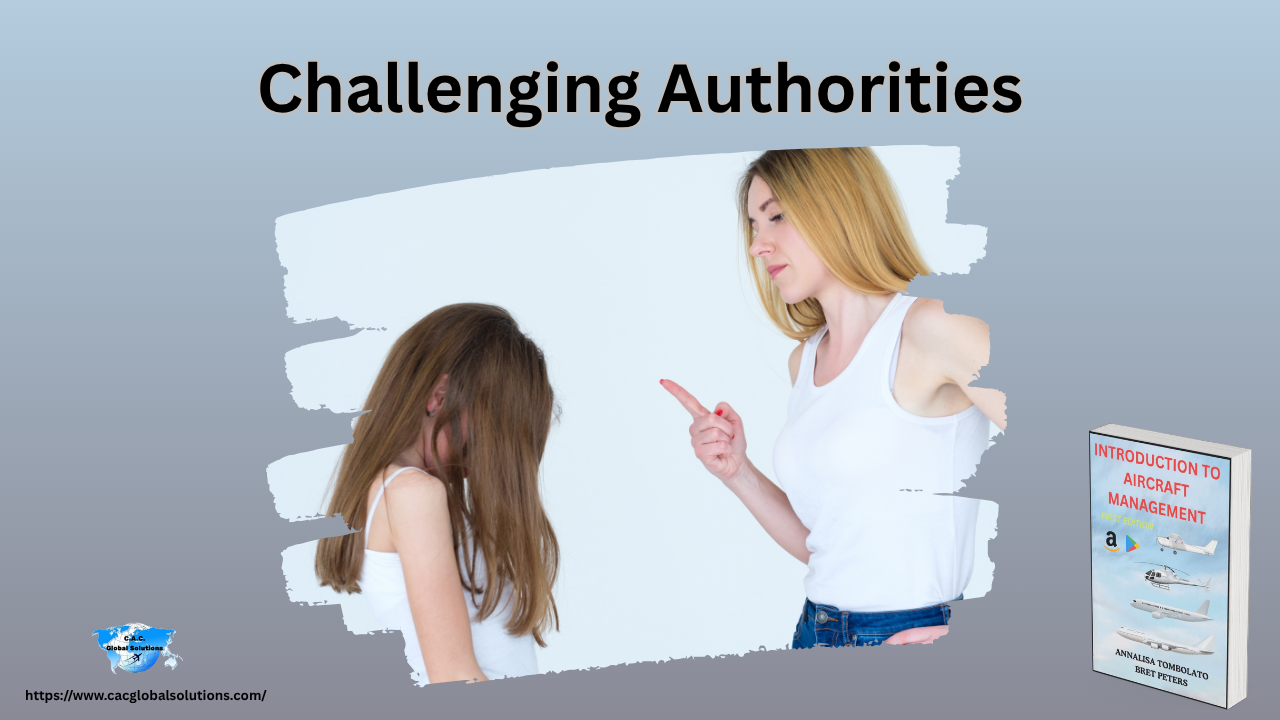
For most people, challenging authority of any kind is usually stressful and makes one question whether they should be doing so, or not. Although, in different situations and contexts, we’ve all been doing so our entire lives.
It’s understandable how people might struggle with this type of challenge. After all, authority figures are typically considered to be highly knowledgeable, experts in their fields, and convincing in whatever they are an authority of; and they often explicitly have formal powers bestowed upon them to exercise control over situations.
Consider for instance, children perceive parents as the ultimate authority; whether it’s simply perception, implied, or explicitly stated in court orders or otherwise embedded in some sort of legal framework. Parents have authority over them, and they’re usually quite convincing of that fact. Meanwhile, what child hasn’t challenged his or her parents’ authority; not turning the lights out when told to do so, breaking a curfew, or doing something that our friends talk us into.
Similarly, citizens implicitly trust that police officers and political figures always do what is in the publics’ best interests. However, I don’t imagine that there is anyone that hasn’t seen examples of where this isn’t necessarily the case.
In aviation, we’re generally a professional group of highly trained people, however we’re also not immune to authority challenges.
Challenging an authority is something that most aviation professionals find uncomfortable to do but, in some instances, it is actually necessary.
Consider that an “authority” may not just be an inspector; meaning a person representing a competent Civil Aviation Authority. It can just as easily be your boss, a Post Holder, maintenance supervisor or manager, a pilot-in-command or an auditor.
We trust that management always do what’s in a company’s best interest and provide appropriate direction, that we often don’t question. However, anyone can indeed make mistakes or misjudge situations. In these cases, what do you do? A perfect example that we all understand immediately is the pilot-in-command / second-in command flight deck situation. What if the PIC is making what appears to be the wrong decision? He is the authority; do you challenge him/her?
Do you just continue down the path accepting direction that’s contrary to the interests of your employer, or the public at large; or do you speak up and say something about it?
Challenge of any sort, administered incorrectly, can be perceived wrong and grossly exaggerated or taken out of context in the mind of the recipient. Nonetheless, I believe that it’s our social responsibility to not just accept something that we believe to be wrong. In fact, I believe we have a moral obligation to say something when we see something that’s not right.
So again, what to do?
Firstly, you have to keep in mind that virtually everything in our world boils down to perception, and that no two of us hold exactly the same perspective. Aside from seemingly obvious observations, our perspectives are always influenced by our past experiences and affect the lenses that we each view the world through. What we think we perceive quite often isn’t the way things actually are. Particularly in this new world where not everything we hear, or see with our own eyes, is necessarily real.
This is one of the reasons why aviation is full of formalized procedures. They’re embedded in almost every area, from Flight Ops to Maintenance to Air Traffic Control, and beyond; to make sure everybody knows what to do and how and to minimize interpretation. However, as a regulator, I’ve seen clients and colleagues interpret requirements or situations in very personal ways many times, sometimes incorrectly, and often unnecessarily turning simple situations into difficult ones; occasionally alienating others in the process.
If you decide to challenge an authority, whoever that might be, be cautious of how you present your case.
Keep in mind that you should always be as certain as possible in support of your position on a matter, and that the person you’re dealing with may be equally, or more, sure of his or herself. Trying to force your perspective on another person rarely works, and almost never goes smoothly. I learned early in my career, when challenging an FAA Inspector on an issue (that he was clearly wrong about), that you have to leave a person a way to vacate his or her position for them to save face.
Some people, when challenged, double down or, in some instances, they even circle the wagons and prepare for a last stand so to speak. In the end you may win a battle, but now you’ve set the stage for a potentially uncomfortable future. Keep in mind that the person you might be challenging may have legitimate authority of some sort. Spite is often brought on by resentment and that can come back to bite you one day.
Challenging anybody should always be done constructively. Always try to help the other person consider that a situation may be perceived differently by different people with other perspectives, or that perhaps he or she may not be aware of, or considered, all relevant details.
Some challenges are no-brainers. I once grounded an aircraft 20 minutes before departure due to a fuel leak. The captain (the authority) in this situation, quite assertively, asked if I was certain (as this was a VVIP flight), but I held my ground; and it was respected. I was then later challenged about the decision by my boss, but it’s hard to argue against a safety case; and he wasn’t there.
However, sometimes it seems that there just may not be any winning. This is when you need to decide; is it worth jeopardizing what might be considered a stable relationship or is it important enough that you risk it all. I’ve been here a few different times in my life, and my career. From my point of view, if it’s really important you have to express your position. You need to be true to who you are and what you stand for.
Another more recent example is a decision that was made by a Civil Aviation Authority’s regional office that I believed to be wrong. It wasn’t based on regulation, but rather interpretation of policy.
The decision was contrary to everything I understood and believed to be right, so I formally challenged it. Fortunately, my taking the matter further garnered a closer look by the head office and resulted in my favor. Clearly, it doesn’t always work out that way, and you have to be prepared to lose and potentially damage relationships.
As a Civil Aviation Safety Inspector, I relish challenge.
To be clear, it’s not that I enjoy confrontation but rather I welcome the opportunity to either teach or be taught; depending on what end of the challenge I’m on. I contend that all challenges can be opportunities, so long as both parties are open-minded and are genuinely trying to be constructive.
This is how we move forward. Through open, unfettered, discussions leading to objective assessment and evaluation. Whether challenges take place in cockpits, offices or hangars, they’re precious lessons (in disguise) that expand our knowledge and awareness and influence who we are and where we’re headed.
Bret - Aircraft Management Specialist, TCCA MD-M, Former Civil Aviation Safety Inspector, Co-Author of "Introduction to Aircraft Management"
